Synopsis
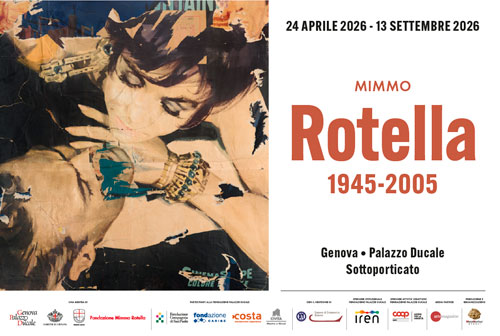
Twenty years after the death of Mimmo Rotella (1918–2006), Palazzo Ducale in Genoa dedicates a major retrospective to one of the absolute protagonists of twentieth-century Italian and international art. The exhibition Mimmo Rotella. 1945–2005, curated by Alberto Fiz and created in collaboration with the Mimmo Rotella Foundation, retraces over sixty years of the artist’s activity, conveying the complexity and relevance of a research that has radically shaped the relationship between art, image, and contemporary society.
The exhibition analyzes Rotella’s entire creative career, from the first abstract experiments of the post-World War II period, influenced by surrealism, to the New Icons of recent years, created through collages and overpaintings in which the medial universe is once again subjected to a process of destructuring and re-signification. Over one hundred works from museums, foundations, and international public and private collections comprise a journey divided into five thematic sections, allowing us to rediscover the innovative power of a language capable, like few others, of recounting the birth and evolution of the image and consumer society.
The fulcrum of the exhibition is the décollage, Rotella’s most radical symbolic gesture. The tear becomes an absolute and disruptive act, capable of opening new openings to perception and redefining the relationship between art and life. As curator Alberto Fiz states, «what is on the surface no longer matters, but the fragmentary and fragmented appearance of a real dimension destined to change under the complicit gaze of the observer».
On display at the Palazzo Ducale are some of the artist’s most emblematic works, including Naturalistico (1953), a collage on canvas with mirrors and glass, The Tiger (1962), The Point and a Half (1963), among the first interventions on the advertising world, and Tender Is the Night (1962), alongside a selection of works dedicated to his most famous icon, Marilyn Monroe. Among his later works stand out a large Untitled from the 1990s, a three-meter sheet metal décollage, and Attenti, the last large décollage created by the artist.
Always guided by a profound attention to the fragment, Rotella transformed the tear into an aesthetic and political gesture, an act of revelation that lays bare the truth hidden behind the images of consumption. Alongside the décollages, the exhibition delves into his most experimental techniques –from artypo to effaçage, from frottage to emulsified canvases, from photographic portraits to extroflexions – testifying to the variety and coherence of an extremely layered research, in which the artist presents himself as a lucid witness to the technological revolution.
This desire to go beyond the surface, investigating matter in its deepest aspects, led Rotella in the 1980s towards overpainting, in autonomous dialogue with the return to painting that characterized many European experiences, including the Transavanguardia. Likewise, the artist does not give up the comparison with graffiti, just as he had been able to compete with Pop Art in the 1960s.
Set up in the rooms of the Loggia degli Abati, the exhibition is also enriched with archival materials and audiovisual documents that contribute to an immersive journey, capable of conveying the complexity of a central figure in the history of contemporary art.
Celebrating Mimmo Rotella twenty years after his passing means recognizing, even in the age of social media, the surprising relevance of his gaze and the strength of an art that continues to question us about the role of images, the fragility of memory, and the beauty of creative disorder.